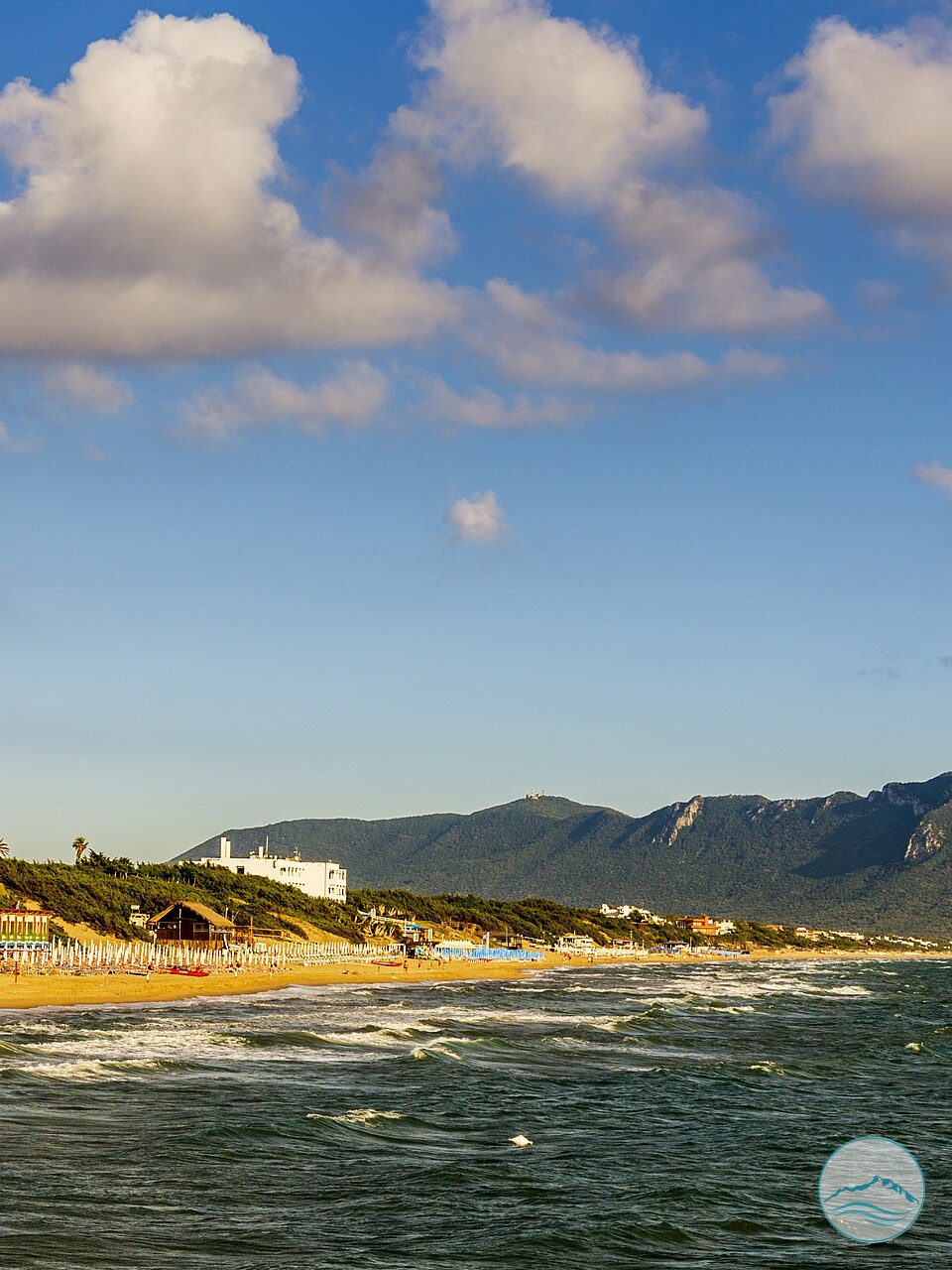
The Ancient Gate, which opens onto one of the most characteristic corners of the Historic Centre with a wonderful view over the Agro Pontino towards the Gulf of Gaeta, shows three overlapping building phases, corresponding to as many historical periods.
The first phase dates to the end of the 4th century BC and is represented by a stretch of first-style polygonal walling, identical to the stretch of Cyclopean walls of ancient Circeii in Via Gino Rossi. Here too the roughly hewn limestone blocks are laid without mortar.
Leaving through the Gate, on the right-hand wall you can see a stretch of opus incertum made of small limestone blocks, documenting the second phase, perhaps carried out in Sulla’s time to reinforce the original polygonal jamb.
The current appearance, by contrast, is medieval and can more precisely be attributed to the Templars, in the mid-13th century. The Gate has a beautiful pointed arch made of squared blocks of local limestone, resting on two marble corbels decorated with a simple moulding. The restraint of the decoration and the pointed arch, clearly of Cistercian origin, closely recall the doorway of the Templar hall in Piazza Lanzuisi, and both refer to the austere architectural language of the nearby abbey of Fossanova.
The Ancient Gate was the main entrance to the town from ancient times, since it was from here, after a right-angled bend, that the decumanus of Circeii began, leading on the opposite side to the North Gate, now called the Ponte. From the North Gate the decumanus continued along the foothill road to the north-west, joining the road that skirted the Peretto hill and ran down towards La Mola.