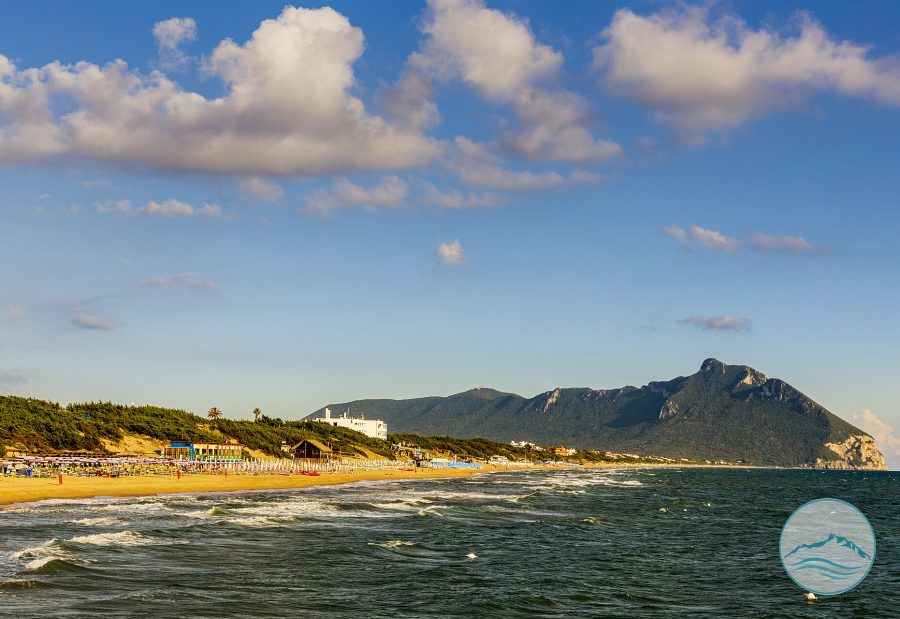
Historic green space in the centre of San Felice Circeo, once a vineyard belonging to the baronial court and now a public garden and belvedere, one of the best-loved viewpoints on the Pontine coast. Rising sheer above the coast, the garden of Vigna la Corte offers one of the most striking views of the village, ranging from the sea to the promontory, and is a favourite place for walks for residents and visitors alike.
Vigna la Corte lies against the north-eastern side of the medieval walls of the Historic Centre. In 2006 the Municipality of San Felice redeveloped the area, creating a public park with an enchanting view over the Gulf of Gaeta.
The name comes from the area’s former use: in the past it was cultivated first by the feudal lords of the castle and later by the Apostolic Chamber. The stretch of wall surrounding the area is part of the defensive system created by the Templars to protect the castrum of San Felice; it continued along the southern side, now incorporated and hidden by modern plaster, until it joined the stretch of wall, still standing, facing Piazzale San Francesco.
In keeping with reuse, typical of medieval building, this stretch of wall was also built with recycled Roman material: small bricks and clay tiles, marble fragments of lintels and squared blocks of local limestone. The technique is the same as that of the Tower: limestone blocks laid in irregular, wavy courses, alternating with courses of reused small bricks or marble fragments.
This irregularity is not constant along the whole wall: it is especially typical of the southern and western sides, while in this stretch of Vigna la Corte, in the eastern corner of the village facing the sea, the courses are more regular, almost straight.
Two of the arrow slits that dotted the walls survive here, used by the patrolling guards to watch over the plain below. One is in the north-eastern corner of Vigna la Corte and seems to have been reworked by later restorations, as the top of the wall is missing and the stone blocks are irregular in both shape and arrangement. Looking out, you can admire the mountain in the direction of the road that led to the Monticchio hill.
A second arrow slit, in the eastern corner, is remarkably well made, careful and regular, showing the high skill of the craftsmen at work during Templar rule. The opening is topped by a limestone block acting as a lintel, surmounted by a flat arch of small rectangular stones arranged in a fan to transfer the weight of the wall above from the lintel to the sides. From this opening you can admire the beautiful sea towards the Gulf of Gaeta, a view that must surely have charmed the lonely soldiers keeping watch over the plain below.
One might think that specialised workers carried out this stretch of wall with all their skill and expertise, but the technique and the use of the same materials rule this out, suggesting a single building campaign directed by a single team of builders.