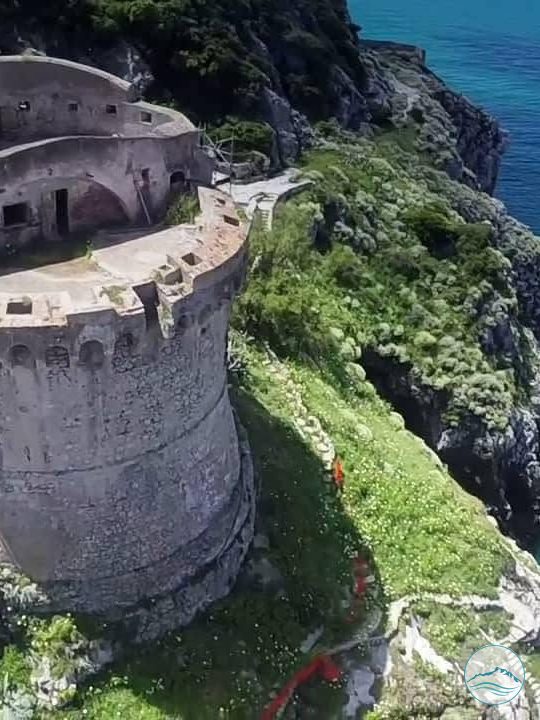
Roman bath complex found near Torre Paola, at the western end of the promontory, in an area that in ancient times also hosted the port-canal connecting Lake Paola (today Lake Sabaudia) with the sea. The site bears witness to the level reached by Roman residential and hydraulic engineering along this stretch of coast, where the wealthiest families of Rome, including, according to tradition, Marius, Cicero and the emperor Tiberius, owned villas and residences overlooking the sea.
The remarkable bath complex of Torre Paola dates to the end of the Republic, with a later reorganisation in the early Imperial period. It was uncovered in 1934 during works on the foothill road between Torre Vittoria and Torre Paola. It is a bath building, previously mistaken for a columbarium or funerary building. It consists of two adjoining rooms with barrel vaults. The first room, interpreted as an apodyterium or changing room, has several semicircular niches along its walls for storing bathing items. Up to the height of the niches, the base of the walls has a decorative band of red plaster, while the floor is white mosaic. One of the short sides of the first room leads to a small heated room with a circular plan and a low dome, probably a laconicum. Among the various rooms of baths in Ancient Rome (tepidarium, caldarium, frigidarium, laconicum), the laconicum was the final and hottest room, heated with very hot dry air, similar to today’s Turkish baths. The second, larger room has the same red decorative base, while the floor, raised on small brick pillars or suspensurae, is decorated with white mosaic framed by a black band. Here too semicircular niches open in the walls, while two large arcosolia increase the capacity of the room. Under the larger of the two arcosolia there is a rectangular basin with a step.