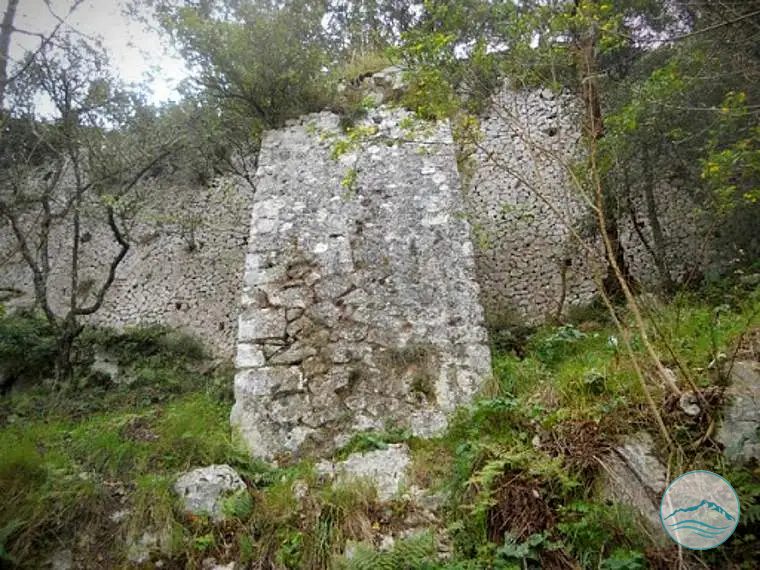
Near the summit of the promontory, the site traditionally associated with the cult of the sorceress Circe combines archaeology and myth, and is one of the places where the bond between Mount Circeo and the classical tradition is most evident.
The sanctuary site features a rectangular platform obtained with a supporting base measuring about 40 x 25 metres. On the southern side, facing the sea, it is built in polygonal masonry tending towards squared blocks, with traces of mortar between them; on the northern side, towards the plain below, in opus incertum. The imposing base rises almost sheer along its entire perimeter, except on the west side, where a rectangular projection was built at the point where two access roads met.
The first road was the ancient coastal road along the mid-slope which, starting from the town of Circeii, ran along today’s Via del Faro and continued towards Vasca Moresca. At the Precipizio the road climbed quickly, supported in places by polygonal walls, and with a series of hairpin bends reached the highest point of the promontory at 541 metres above sea level.
A second, much easier road branched off from the foothill road at Torre Paola, and it is the one still used today to reach the Picco. This trail is marked within the Park in yellow and red.
The different building techniques used on the two long sides of the base suggest that the oldest part, in fourth-style polygonal masonry, dates to the end of the Republican period, around the 2nd century BC, while the stretch in opus incertum dates to the Antonine period (138-193 AD). The site, however, was affected by later interventions that continued into the Middle Ages.
After the fall of the Roman Empire and the power vacuum at the top of the Italian peninsula from the end of the 5th century, we must assume that Circeii too underwent a general decline common to most Italian towns. The steady drop in trade, the abandonment of the great coastal villas, the resulting spread of malaria and the gradual depopulation of the Roman town led to a general worsening of living conditions for the local population.
We must suppose that the inhabitants of ancient Circeii, a town partly abandoned and in decline, and often threatened by increasingly frequent raids by the Vandals and Goths, took refuge in the highest and most inaccessible places on the mountain.
This possibility is supported by the different name used for our town in medieval documents. Two different place names appear in them: in all documents prior to 1240, the year in which the Templars are thought to have arrived at the Circeo, there is mention only of Rocca de Circegio, Rocca Circea, locus qui vocatur Circellu.
The name Castrum Sancti Felicis appears for the first time in 1259. This raises the question of which Rocca is mentioned in the sources earlier than 1240.
According to the most recent studies, the fortress or Rocca was built precisely on the highest point of the mountain, on the foundations of the ancient sacred place dedicated to Circe; the fillings with reused terracotta material found in the gaps of the Roman substructures of the temple would date to the medieval period.
Although the Rocca-Altar of Circe was recognised from the earliest times as essential for the defence of the Tyrrhenian coast, it officially enters papal records only in the 12th century, when Pope Paschal II entrusted it to Cardinal Hugh of Alatri, of the Twelve Apostles.